

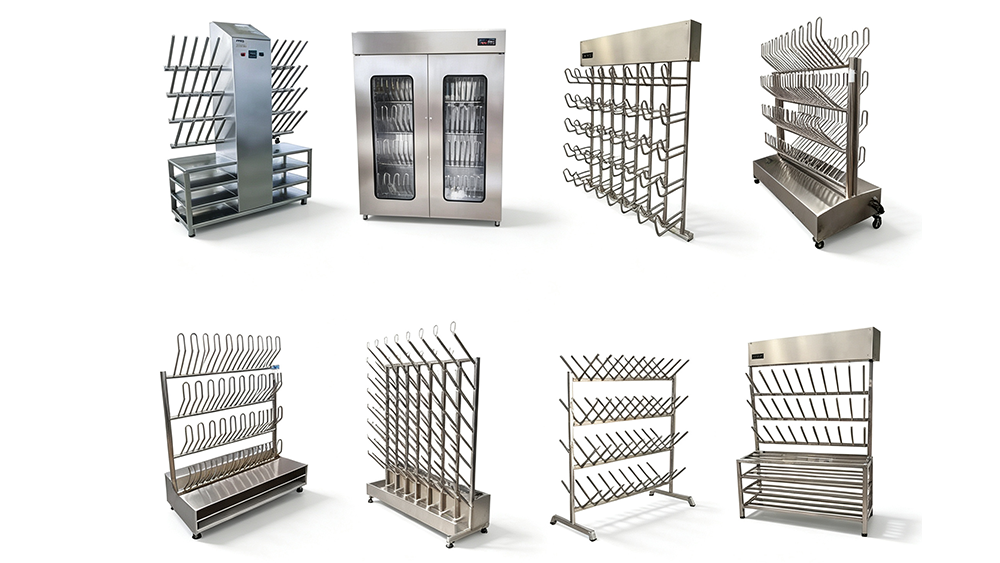
Boot Drying Rack: Why Drying Matters as Much as Washing in Food Plants
Most facilities invest in a boot washing machine — then let the problem end there.
Workers step out of the washer with clean but soaking-wet boots. Those wet boots go straight into the locker room, get sealed in a dark cabinet, and sit there for hours. In that warm, damp environment, bacteria and mold multiply rapidly. By the next shift, the “clean” boots are actually one of the most contaminated items in the plant.
The missing step is drying. A dedicated industrial boot drying rack dries and sanitizes footwear properly, extending both hygiene and boot lifespan. Here is what you need to know.
What Is a Boot Drying Rack?
A boot drying rack (also called a boot dryer, boot drying cabinet, or industrial boot drying system) is a stainless steel rack system equipped with warm air blowers. Workers hang their washed boots upside down on the rack; warm, circulating air is blown into the boot interior and over the outer surface to dry them quickly and evenly.
It is typically installed in locker rooms, changing rooms, or near the boot-washing station — wherever footwear needs to be stored and dried between shifts.
How Does It Work?
A typical industrial boot dryer operates simply:
- Hang — workers place washed boots upside down over the drying nozzles.
- Blow — warm air (usually 40–60°C) is circulated into the boot interior and across the surface.
- Dry — moisture evaporates quickly; some models include timed cycles or automatic shut-off.
- Store — dry boots stay on the rack, ready for the next shift.
Because the air circulates through the boot interior, even heavy rubber boots dry completely — not just on the outside.
Why Drying Is a Critical Hygiene Step
- Prevents Bacteria & Mold Growth — damp footwear is the ideal breeding ground for microbes; drying cuts the cycle.
- Extends Boot Lifespan — rubber and lining degrade quickly when kept wet; proper drying reduces cracking and odor.
- Improves Worker Comfort & Compliance — dry boots are more comfortable, so workers are more likely to follow hygiene procedures.
- Supports Audit & Certification — a visible, documented drying step strengthens GMP / HACCP compliance.
Key Features and Benefits
- 304 Stainless Steel Construction — corrosion-resistant, washdown-friendly, and durable in humid environments.
- Warm Air Circulation — dries both boot interior and exterior quickly and evenly.
- Multiple Drying Positions — accommodates multiple pairs at once, sized for shift-level throughput.
- Timed / Auto Shut-off Cycles — energy-efficient and safe for overnight operation.
- Compact, Wall-Mountable or Floor-Standing Options — fits locker rooms and corridors of any size.
- Low Energy Consumption — designed for continuous daily use without high utility costs.
- Low Noise Operation — suitable for quiet changing-room areas.
Which Industries Need One
| Industry | Why It’s Needed |
|---|---|
| Meat, poultry & seafood processing | Boots washed frequently; must be dry before reuse |
| Dairy & beverage production | Prevents damp-environment contamination |
| Pharmaceutical & cosmetics | Supports GMP changing-room requirements |
| Livestock & poultry farms | Stops disease spread via damp, soiled footwear |
| Food service & kitchens | Keeps work footwear hygienic and odor-free |
| Mining, construction & heavy industry | Dries work boots quickly between long shifts |
Boot Drying Rack vs. Air Drying
| Aspect | Natural Air Drying | Boot Drying Rack |
|---|---|---|
| Drying time | 12–24 hours or more | 30–60 minutes |
| Bacteria risk during drying | High (stays damp for hours) | Low (dries fast) |
| Space efficiency | Needs open space, boots scattered | Compact, organized storage |
| Odor control | Poor | Good |
| Audit visibility | Not verifiable | Documented process |
| Winter / rainy season performance | Unreliable | Consistent |
How to Choose the Right Boot Drying Rack
Ask these questions before buying:
- Capacity — how many pairs per shift do you need to dry at once?
- Heating method — confirm the warm-air temperature range suits your boot material (rubber, PVC, leather).
- Timer / auto shut-off — needed if the unit will run overnight unattended.
- Installation type — wall-mounted or floor-standing, based on your locker room layout.
- Power requirement — check voltage and energy consumption for your site.
- Certification — for export or regulated industries, confirm CE and other relevant standards.