

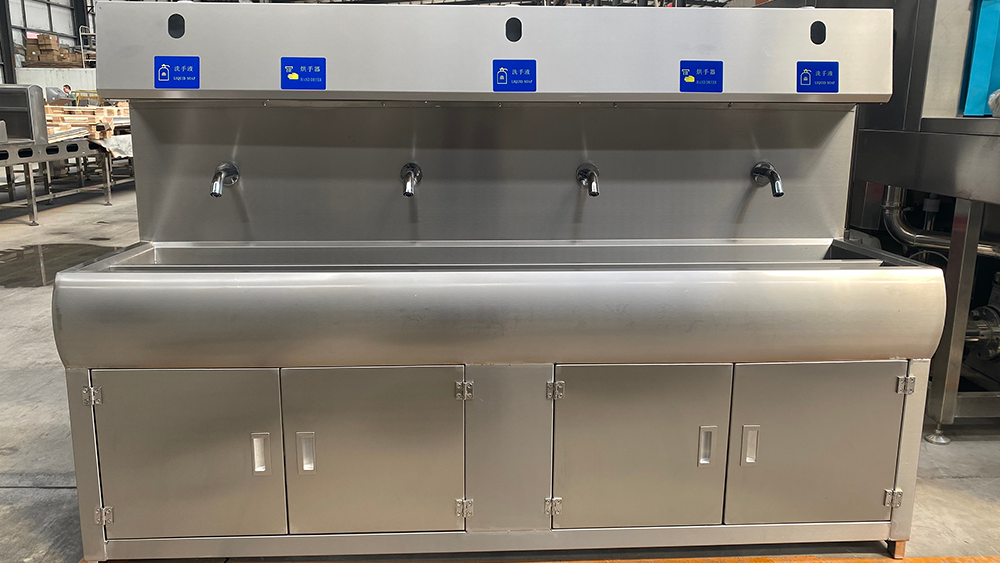
Stainless Steel Hand Wash Sink: The Finishing Touch of Your Facility Hygiene Line
nYou have installed a boot washing machine at the entrance. You have added a boot drying rack in the locker room. But the most important contamination vector is still standing right at your clean-zone door: the worker’s hands.
nHands touch raw materials, door handles, and equipment hundreds of times per shift. If there is no fast, reliable hand-washing point at the hygiene boundary, everything before it — the boot washer, the air shower, the disinfectant footbath — is undermined.
nA stainless steel hand wash sink (also called an industrial hand washing station, or commercial hand wash basin) is the standard solution: a durable, hygienic, hands-free washing point designed for high-traffic food, pharmaceutical, and clean-production environments. Here is what you need to know before you buy.
nWhat Is a Stainless Steel Hand Wash Sink?
nAn industrial hand wash sink is a wash basin made from food-grade stainless steel (typically 304), designed specifically for strict hygiene environments. Unlike a normal restroom sink, it is built to be:
n- n
- Hands-free — activated by knee, foot pedal, or infrared sensor, so workers never touch the faucet. n
- Fully washdown-able — no crevices, no corrosion, easy to clean and disinfect. n
- High-throughput — sized and positioned for fast use during shift changes. n
It is installed at the entrance of clean zones, changing rooms, and production areas, usually as part of a complete personnel hygiene station.
nWhy Hands-Free Matters
nThe entire point of washing hands is to remove contaminants. If a worker then touches the same faucet handle that the previous worker touched, the contamination comes right back.
nHands-free activation solves this:
n- n
- Infrared sensor — automatic on/off, zero contact, most hygienic. n
- Knee operation — mechanical, no electronics, very reliable. n
- Foot pedal — simple and low-cost, commonly used in food plants. n
Many industrial sinks combine these with soap dispensers, hand dryers, and even disinfectant stations built into a single compact unit.
nKey Features and Benefits
n- n
- 304 Stainless Steel Construction — food-grade, corrosion-resistant, and built for daily washdown with chemicals and hot water. n
- Hands-Free Activation — sensor, knee, or foot-pedal control to prevent re-contamination. n
- Integrated Soap Dispenser — mounted on the unit, one-step wash for faster throughput. n
- Hot & Cold Water Mixing — comfortable washing temperature, encouraging correct handwashing behavior. n
- Deep Basin Design — reduces splash and keeps the surrounding floor dry and safe. n
- Smooth, Seamless Welding — no sharp edges or hidden crevices where bacteria can accumulate. n
- Optional Integration — can be combined with hand dryers, disinfectant stations, and even in a single all-in-one hygiene unit. n
Which Industries Need One
n| Industry | nTypical Use | n
|---|---|
| Food processing & meat plants | nMandatory hand wash point at clean-zone entry | n
| Dairy & beverage production | nSupporting HACCP and food safety audits | n
| Pharmaceutical & cosmetics | nGMP-compliant hand hygiene | n
| Livestock & poultry farms | nDisease prevention between zones | n
| Catering & central kitchens | nFast, high-volume hand washing | n
| Hospitals & laboratories | nInfection control | n
Hand Wash Sink vs. Standard Sink
n| Aspect | nStandard Bathroom Sink | nIndustrial Stainless Hand Sink | n
|---|---|---|
| Activation | nManual faucet (touch) | nHands-free sensor / knee / foot | n
| Material | nCeramic, easy to chip | n304 stainless, washdown-proof | n
| Re-contamination risk | nHigh | nEliminated | n
| Chemical resistance | nLimited | nExcellent | n
| Compliance fit | nNot suitable | nDesigned for HACCP / GMP | n
| Throughput | nSlow | nFast, high-volume | n
How to Choose the Right Hand Wash Sink
nAsk these questions before you buy:
n- n
- Activation type — sensor, knee, or foot pedal? Sensor is most hygienic; foot pedal is most reliable and economical. n
- Number of basins — one basin per ~10–15 workers is a common planning rule; confirm for your shift size. n
- Water supply — do you need hot water? Confirm heater and mixing valve requirements. n
- Integrated accessories — soap dispenser, hand dryer, disinfectant station — which do you need? n
- Installation — wall-mounted, counter-top, or free-standing, based on your changing room layout. n
- Certification — for export or regulated industries, confirm CE and other relevant standards. n